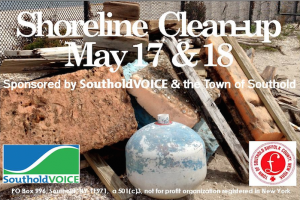
SHORELINE CLEAN-UP MAY 18-19
Southold Township has over 160 miles of shoreline and close to fifty major creeks, ponds and inlets; our shoreline, both public and privately owned (to MHW), is a major asset to this town and should be cared for analogous to what is done for all other property throughout town during the spring and fall clean-ups.
Therefore, a cooperative effort is underway where the public and private sector are working together to care for “Where the BLUE meets the GREEN.” In cooperation with SoutholdVOICE, a non-profit organization of waterfront property owners, the Town will have a shoreline clean-up on the weekend of May 18, 19.
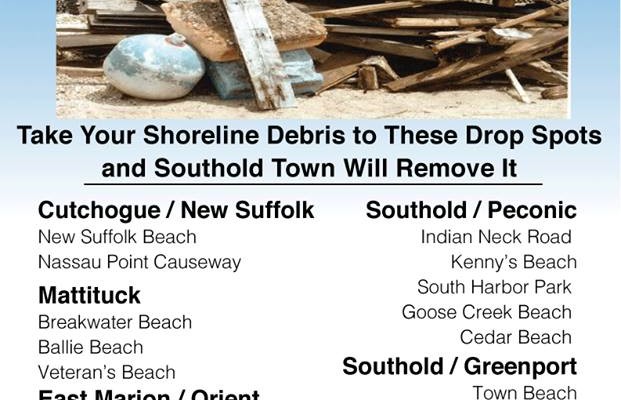
Residents will be able to bring any flotsam, jetsam or other shore laden debris to fifteen designated drop spots throughout the Town, where Town personnel will remove it. Residents will also be able to bring any of this debris, over the scales, at the Town’s Transfer Station in Cutchogue free of charge. Flotsam, jetsam, and other debris shows up on the shoreline areas of the Town through tidal action, storms, or neglect. Items can range from balloons, all types of plastics, used hygiene products, tires, tree limbs (and entire trees), dock pieces, flotation, and boat parts – basically anything that has the smallest capacity to float
Large signage will be placed at each drop spot prior to the clean-up. The selected drop spots are:
MATTITUCK
1 Breakwater Beach (Sound)
2 Bailie Beach (Sound)
3 Veterans Beach (Bay)
CUTCHOGUE/NEW SUFFOLK
4 Town Transfer Stations (over the scale)
5 New Suffolk Beach (Bay)
6 Nassau Point Causeway Beach (Bay)
SOUTHOLD/GREENPORT
7 Town Beach (Sound)
8 Sound Drive/67 Steps (Sound)
SOUTHOLD/PECONIC
9 Indian Neck Road (Bay)
10 Kenney’s Beach (Sound)
11 South Harbor PARK Beach (Bay)
12 Goose Creek Beach (Bay
13 Cedar Beach (Bay)
EAST MARION/ORIENT
14 Truman’s Beach (Sound)
15 Land’s End (Sound)
No Need to Fight over Conservation
The following article appeared in the February 14th edition of the Suffolk Times as a “Guest Spot”
Having attended two recent Southold Town government meetings – one for changes to a town code and the other regarding the Natural Resources chapter of the Towns in-development Comprehensive Plan, I observed pointless division of opinion and misconceptions that do not help anyone. I saw a significant opportunity missed!
Environmental activists are preachy about making everything “sustainable,” but when it comes to the rights of property owners, they seem to forget that we [waterfront property owners] are a part of the ecosystem as well, or would they prefer we become extinct. Property owners are a significant resource being wasted. And, waterfront property owners in particular are dedicated to achieving a healthy balance between the legal rights of private property owners and ensuring sensible (and sustainable) protections are afforded to all natural and living resources.
Many environmental activists view the legal protection of private property as an obstacle to environmental sustainability. To the contrary, private property and property rights have been a core American value since the nation’s inception and are recognized as a significant resource in environmentalism.
The importance of property rights in determining the use and value of environmental assets has been noted by both economists and legal scholars since the middle of the 20th Century. Nothing has changed in that regard. “Particularly in the case of natural resources, property rights are a viable and demonstrated means of enhancing sustainability, particularly when compared to the available political alternatives,” writes Megan McArdle of The Atlantic . Continuing, she states: “At the same time there is increasing evidence that a failure to respect and protect property rights undermines environmental stewardship… .”
In a recent letter to the Suffolk Times, Howard Meineke wrote: “Waterfront property owners should be in the forefront of the clean water advocates. Clean and productive marshes, creeks and bays are their prime asset. It should be a major concern.” I completely agree, however, solutions cannot be suggested or implemented with the trampling of property rights.
The agricultural community would not accept that principle, and neither do waterfront property owners.
What is missing in the equation is recognition of the conservation efforts of individual private landowners, and waterfront property owners in particular, and a renewed appreciation of private property rights in the drafting of environmental policy.
Waterfront property, whether it be on the bay, a creek or the Sound, is special and its owners recognize that fact. They too understand the principles of conservation and sustainability. Each and every owner has worked hard to own their property and continues to do so to maintain it and its value. Waterfront Property owners are a significant resource in the conversation.
Why then is it felt that the trampling of property rights of waterfront owners to be the solution? Is it politically expedient? Is it easy to sell? Is it: you have it and I want it?
An opportunity missed!
We try to be and should be part of the solution. Waterfront owners bring a significant voice and understanding of the issues. Yet, they are looked at as an adversary rather than an asset. An opportunity missed!
John Betsch
EROSION OF PROPERTY VALUE
The January 15th Southold Town Public Hearing regarding changes to Chapter 111 Coastal Hazard Areas may not directly affect every waterfront property owner but the suggested changes appear to be symptomatic of probable future code changes which will affect every waterfront property owner. The changes to Chapter 111 appear to be another regulatory take away and erosion of property value.
The suggested definition change, which may appear innocuous, has significant ramifications.
Present Chapter 111 Town Code as well as NYS DEC Part 505: Coastal Erosion Management defines major addition as a 25% or greater increase in ground area coverage of a structure. Ground area coverage would include items like decks, breezeway, garage etc. This new code change now significantly reduces that allowance to only “principal building and a principal livable floor area” and will be defined as:
LIVABLE FLOOR AREA – All spaces within the exterior walls of a dwelling unit, exclusive of garages, breezeways, unheated porches, cellars, heater rooms and approved basements having a window area of less than 10% of the square foot area of the room. Usable floor area shall include all spaces not otherwise excluded above, such as principal rooms, utility rooms,bathrooms, all closets and hallways opening directly into any rooms within the dwelling unit. [Extracted from thedraft code]
First there was a Code change reducing the building coverage allowance of a property lot to 20% of “buildable area” as determined by the Town and now this recommended change reduces a property owners allowance from an increase of 25% of “ground area coverage” to limiting it to 25% of a “principal livable floor area” building (defined above and excluding breezeway, garages, decks etc.) Each of these changes affects property value!
The waterfront property owner’s ability to utilize their property is again being eroded – while their contribution to the tax rolls of Southold remains unchanged
Watch the video of the January 15th Public Hearing on Channel 22 or use the citation below and decide for yourself
North Sea Drive, which is located on the LI Sound between Kenney’s Road and Horton Lane was discussed extensively throughout the hearing discussion. When an elected official representing the regulatory agency concerned with Town waterfront in his enthusiasm to rationalize the recommended change makes untrue statements like: “Some homes on North Sea Drive are so big that they cast huge shadows on their smaller neighbors and the sunlight never even comes in.” [It should be noted that on North Sea Drive, the sun rises in the front and sets in the rear of homes (or the reverse) which makes that statement impossible and the average lot size on North Sea Drive is also greater than a half-acre as documented by Tax Map 1000-054-4-lots 4-24] Waterfront Property owners need to be extremely concerned
I am a strong believer in the effectiveness of public-private partnership. However, when waterfront property owners are disproportionally singled out, we need to be heard.
Each individual comment sent to Town government provides a significant cumulative effect regarding constituent opinion. While this particular change may not directly affect every waterfront property, there have been changes in the past and there will are anticipated changes in the future that will.
Should you also be concerned about property value and property rights for these changes or any future changes, email or call the Town Board with your comment.
Scott A. Russell, Town Supervisor scott.russell@town.southold.ny.us
Luisa Evans, Town Board Member lpevans@fishersisland.net
Albert Krupski, Town Board Member / Deputy Supervisor alkrupskitown@yahoo.com
Christopher Talbot, Town Board Member christptal@yahoo.com
William P. Ruland Town Board Member Rulandfarm@yahoo.com
Jill Doherty, Town Board Member jill.doherty@town.southold.ny.us
The Chapter 111 changes were not voted on at the January 15th Public Hearing and were tabled. However, it was brought to a vote at the next meeting held on the 29th. It passed 4-1 with the following votes: Supervisor Russell, Councilman Doherty, Evans and Ruland – YES; Councilman Talbot – NO. Will the Board’s action on Chapter 111 be indicative of their future concern for property value and property rights?
J. Betsch
Q5: Storm Damage ?
Q 5 Storm Damage: Both waterfront property owners on the LI Sound and waterfront owners and dock owners on the creeks and bays are faced with challenges such as ice damage to docks, gradual erosion from storm surges and Nor’easters, and hurricane damage and erosion. What background or experience gives you a full appreciation of these problems that waterfront property owners confront on a continuing basis?
Q6: Bluff Protection ?
Q6. Bluff protection: Do you support the use of landscape retaining walls to protect Sound-front bluffs? Can we get your support vs. the DEC?
Hurricane Irene preparations
This is not a drill . . . . . This is not a test . . . . . .
Following is the official statement from Southold Town Office of Emergency Management.
FOR IMMEDIATE RELEASE
Date: August 26, 2011
Contact: Scott A. Russell, Supervisor
Re: Hurricane Irene
Hot Topics 2011 – Southold VOICE Meeting
Our Annual Meeting was hosted at Southold Town Recreation Center, on Saturday July 30th at 9am. For the benefit of those who missed the meeting, reasons of accuracy and simply because we have the technology to do it, I’m posting raw (unedited) video of guest speakers in the order in which they appeared.
No Bluffing
Coastal homeowners shouldn’t be held hostage to erosion
by John Betsch

As reported by the Pacific Legal Foundation , a nationwide public interest legal organization defending limited government, property rights, individual freedom and a balanced approach to environmental protection, the following case (while in the state of Washington) has applicability and parallels to any waterfront property owner.
Conservation Advisory Council Targets Waterfront Property Owners
At the March 29th Town Board work session, Peter Young, Chair of the Town’s Conservation Advisory Council, accompanied by council members Doug Hardy and Jack McGreevy, presented a council memo entitled LONG ISLAND SOUND SHORE [recommendations], full text below:
Coastal Erosion Meeting Feb 16th 2011
The Coastal Erosion Meeting originally scheduled Feb 2nd, but postponed ironically because of bad weather, finally went ahead with about 80 members of the public and various government officials. The purpose of the meeting was to explore both short term and long term solutions to the coastal erosion happening on Long Island Sound. One area that is particularly vulnerable is Hashamomuck Cove, which benefits from a group of very active homeowners that have been pushing officials for something to be done since 2006.